

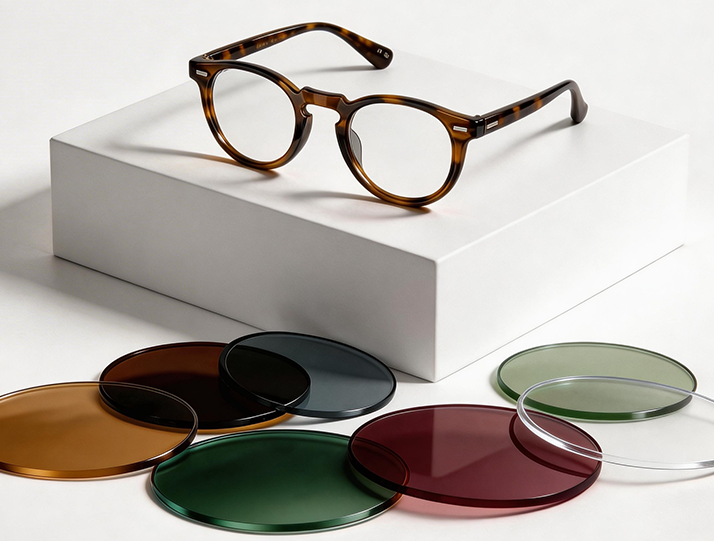
What’s Included with Every Vediview Prescription Lens

Impact-Resistant Lenses
All Vediview lenses are made from lightweight, impact-resistant high-performance optical resin, offering everyday durability without added weight.
Scratch-Resistant Coating
A protective hard coating helps reduce surface scratches from daily wear and handling.
Smudge-Resistant (Hydrophobic) Coating
Our lenses repel moisture, fingerprints, and oils, making them easier to clean and clearer throughout the day.
Anti-Reflective Coating
Reduces glare from screens, headlights, and overhead lighting while improving visual clarity and comfort.
UV Protection
All VediView lenses block UVA and UVB rays to maintain long-term eye health.
Ready to find your perfect lenses?
Shop all prescription glassesor read on to learn what makes Vediview lenses different.
Choosing the Right Lenses for Your Prescription Type

Single-Vision Lenses
Correct either distance or near vision. Commonly prescribed for nearsightedness (myopia) or farsightedness (hyperopia) . Ideal for everyday wear or dedicated reading glasses.

Progressive Lenses
No-line bifocals or multi-focal lenses that provide seamless
correction for distance, intermediate, and near
vision—without visible lines. Designed for presbyopia and
customized to your exact prescription and
frame choice.

Reading Glasses
Single-vision lenses optimized specifically for close-up tasks like reading or crafting. Available in standard or magnified strengths for presbyopia and general near-vision needs.
Shop Frames by Prescription


Spherical vs. Aspheric Lenses:
Which Gives You the Natural Look?
Standard lenses curve like a basketball—uniform in every direction. This pushes the lens away from your eye, creating thick edges and that “bug-eye” look. Our aspheric design gradually flattens toward the edges, like the curve of a car windshield. This lets the lens sit closer to your eye, reducing thickness and making your eyes look natural.

Conventional Spherical Lens


- Curved like a sphere
- Bulges outwards with thick edges.
- Spherical aberration: shifted focus (rays bending too much from edges causing distortion and slight blur.)
VEDIVIEW Aspheric Lens


- Curved like a shallow bowl
- Flatter and slimmer profile
- Aberration nearly eliminated: one focal point (edges look sharp just as well as the center part)
Lens Index Options: Which Thickness is Right for You?
The lens index determines lens thinness and weight. Higher indexes bend light more efficiently, allowing thinner designs, especially for stronger prescriptions. To simplify an astigmatic prescription into a single usable power we calculate the Spherical Equivalent: SE = SPH + CYL/2.

1.56 Index (Basic)
Best for mild prescriptions. Included with many Vediview frames as an economical option.
Best for: SE between ±0.00D and ±2.50D.

1.60 Index
A thinner, lighter option for moderate prescriptions. Ideal for thinner frames or improved comfort.
Best for: SE between ±2.75D and ±5.00D.

1.67 High-Index
Designed for stronger prescriptions with reduced lens thickness. Minimizes edge thickness and visual distortion.
Best for: SE between ±5.25D and ±6.00D.

1.74 High-Index
Our thinnest lens option, engineered for very strong prescriptions. Helps reduce the “coke bottle” effect while maintaining clarity. Learn more on What is high myopia
Best for: SE ±6.25D and above.
| If your prescription looks like this... | Choose this lens |
|---|---|
| SPH up to ±2.50 AND CYL less than ±2.50 | 1.56 - Standard |
| SPH between ±2.75 and ±5.00, OR CYL between ±2.50 and ±4.50 | 1.60 - Thinner |
| SPH between ±5.25 and ±6.00, OR CYL between ±4.50 and ±6.00 | 1.67 - Ultra-thin |
| SPH ±6.25 or higher, OR CYL ±6.00 or higher | 1.74 - Ultra-thin |
We’ve made it even simpler.
Here is a quick visual table which gives you an instant recommendation based on either your SPH or your CYL.
Important - Astigmatism Upgrade Rule (already built into this table)
If your astigmatism (CYL) is ±2.50D or higher, we automatically recommend one index higher than the SE-based suggestion alone. The table reflects this by including CYL thresholds — so you can simply follow the “OR CYL” column without extra calculations.
Not sure what your prescription numbers mean? Learn how to read your glasses prescription first.
If your prescription falls into two different rows, just pick the higher index. Thinner is always lighter.
Still not sure? Just send your prescription to us at [email protected] and we’ll pick the right lens for you. No guesswork, no hassle.
Lens Type Options
Specialized lens coatings can enhance both comfort and visual performance. Below are the available at Vediview.

Blue Light Filtering Lenses
Blue-light blocking lenses are designed to reduce exposure to high-energy visible (HEV) blue-violet light from digital screens and artificial lighting. These glasses may help reduce eye fatigue during prolonged screen use.

Photochromic Lenses
These light-adjusting lenses automatically darken in sunlight and return to clear indoors. They offer convenient, all-day protection from UV light without the need to switch between glasses and sunglasses. Ideal for people who frequently move between indoor and outdoor environments.

Polarized Lenses
Polarized sunglasses reduce glare reflected from flat surfaces such as water, snow, and roads.They enhance contrast and visual comfort, making them ideal for driving, outdoor activities, and bright environments.

Mirrored Lenses
Mirrored sunglasses feature a reflective outer coating that reduces glare and adds a bold, modern look. Available in select colors such as gold, silver, and blue, mirrored tints are popular for outdoor activities and performance eyewear.

Solid Color Tint
Color-tinted lenses add subtle light filtering while allowing for personal style expression. Available in multiple colors and intensities, these lenses can improve comfort in bright environments and add character to your eyewear.

Gradient Tint
Gradient lenses are tinted darker at the top and fade to a lighter shade toward the bottom. They provide sun protection while maintaining clear near vision — a popular choice for everyday sunwear and fashion-focused frames.

Not every lens or frame combination works for every prescription.
Our team reviews every order before production and may recommend adjustments to ensure the best possible result.
Not sure where to start? Read our step-by-step guide on how to order prescription glasses online or contact us with any questions.

FAQ
1. What’s the difference between progressive and bifocal lenses?
Progressive lenses offer a seamless transition between distance, intermediate, and near vision without visible lines. Bifocals have a visible line separating distance and reading areas. Progressives are more modern and cosmetically appealing.
2. Do Vediview lenses block blue light from screens?
Yes. We offer blue light filtering lenses designed to reduce exposure to HEV blue-violet light from digital screens and artificial lighting, which may help reduce eye fatigue during prolonged screen use.
3. What’s the difference between photochromic and polarized lenses?
Photochromic lenses automatically darken in sunlight and turn
clear indoors — all-day UV protection without switching glasses.
Polarized lenses reduce glare reflected from water, snow, and
roads, enhancing contrast for driving and outdoor activities.
4. Are Vediview lenses impact-resistant?
Yes. All our lenses are made from lightweight, high-performance optical resin that is impact-resistant and durable without adding extra weight.
5. How does the smudge-resistant coating work?
The hydrophobic coating repels moisture, fingerprints, and oils, making lenses easier to clean and keeping them clearer throughout the day.
6. Which lens index should I choose for a stronger prescription (-5.25 SPH)?
For SPH -5.25 or higher, we recommend our 1.67 High-Index lenses. They significantly reduce thickness and the “coke bottle” effect while maintaining optical clarity.
7. What’s the difference between single-vision and reading glasses?
Single-vision lenses correct one field (distance or near) for nearsightedness or farsightedness. Reading glasses are single-vision lenses optimized specifically for close-up tasks like reading or crafting.
8. Which lens is best for driving during the day?
Polarized lenses are ideal for driving because they reduce harsh glare from wet roads, windshields, and other flat surfaces, improving contrast and visual comfort.
9. What if my prescription doesn’t work with the frame I choose?
Our team reviews every order before production and may recommend adjustments to ensure the best possible result. You can also see our guide to How to Choose the Perfect Frame or contact us before ordering if you’re unsure.
10. Are progressive lenses available for high prescriptions?
Yes. We customize progressive lenses to your exact prescription and frame choice. For very strong prescriptions (e.g., SPH ±6.25 and above), we recommend our 1.67 or 1.74 high-index options to minimize edge thickness and distortion.